Your backyard stops feeling like spare square footage the moment it starts working the way you live. That shift is happening fast, and smart patio trends are driving it. People are no longer chasing patios that look polished for one weekend photo and fall flat the rest of the year. They want spaces that stay comfortable on a hot afternoon, feel inviting after sunset, and hold up through daily use without turning into a maintenance chore.
The change is deeper than furniture swaps or a new string of lights. It is about treating the patio as a real extension of the home, with the same attention to mood, function, and rhythm. A good outdoor space now has to do more than sit there looking tidy. It needs to host dinner, handle quiet mornings, support family traffic, and still feel calm at the end of a long day. That is why more homeowners are watching where design is headed through outdoor living industry coverage, then applying those ideas in ways that fit their own habits rather than copying a staged catalog setup.
The best patios right now do one thing exceptionally well: they make everyday life easier. Not louder. Not flashier. Easier. And that is the standard worth building around.
Why Smart Patio Trends Are Moving Away From Showpiece Design
A patio used to be judged by how much it impressed on first glance. That mindset is fading because it never served real life for long. Glossy surfaces overheated, oversized furniture clogged movement, and decorative features demanded upkeep without adding comfort. You could admire those spaces from the kitchen window, but living in them was another story.
What is replacing that model is more honest. People want patios that feel settled, useful, and easy to return to without preparation. That means design choices are being filtered through one blunt question: does this make the backyard work better on an ordinary Tuesday?
Comfort now matters more than spectacle
Comfort has become the dividing line between patios that get used and patios that get ignored. Shade placement, seat depth, airflow, and surface temperature all matter more than a dramatic centerpiece. A sculptural fire table might look sharp online, but if nobody wants to sit around it in July or clean it after every storm, it has failed its job.
You can see this shift in how homeowners buy furniture now. They are picking wider chairs with proper back support, softer edges, and fabrics that do not punish bare skin in the heat. That sounds minor until you live with it. A chair that invites you to stay for another twenty minutes beats a photo-ready chair that makes everyone fidget after ten.
The same logic is reshaping outdoor living ideas across new builds and renovations. Designers are stripping away the “show garden” mindset and making patios feel more like low-pressure rooms. That means fewer awkward display pieces and more choices built around comfort, weather, and repetition. People use what feels good. Always.
The strongest patios feel intentional, not crowded
A common mistake in backyard design is adding features to prove the space has value. You end up with a grill island, a bar cart, a water feature, three planters, a rug, lanterns, a bench, and nowhere comfortable to stand while carrying a drink. A patio should not feel like a checklist exploded across concrete.
Strong modern backyard design is more restrained than people expect. It uses fewer objects, but each one earns its place. A built-in bench that doubles as storage beats an extra pair of fragile accent chairs. A single oversized planter with movement and height often does more than six small pots scattered around the perimeter.
That restraint is what gives a patio a sense of ease. You notice it when a guest walks through the space without weaving around furniture. You feel it when the eye lands somewhere restful instead of hopping from one decorative object to the next. Good patios are edited. Ruthlessly, at times. That is not a loss of personality. It is how personality becomes readable.
The Tech Choices Worth Bringing Outside
Once a patio is comfortable, the next question is what technology actually improves it. That answer is narrower than the market suggests. Plenty of outdoor products are built to look advanced while adding one more thing to charge, clean, repair, or replace. The useful choices are the ones that remove friction without demanding attention.
Outdoor tech should disappear into the experience. If you notice the gadget more than the benefit, it is probably the wrong buy.
Smart lighting is carrying more design weight than furniture
Lighting has become one of the clearest signals of where patios are heading. Not because it is flashy, but because it changes how long you stay outside. The right setup extends dinner, softens hard materials, and makes the backyard feel inhabited after dark instead of abandoned. That is why smart patio lighting has moved from novelty to core infrastructure.
Most people still get this wrong by treating outdoor lighting as decoration first. They hang one strand of bulbs, add a couple of solar stakes, and call it a night. The result is patchy, dim, and often harsher than expected. Better lighting starts with layers: a soft overhead source, lower ambient glow near seating, and subtle path or edge lighting for movement.
This is where a little control matters. Scheduled warm lighting at dusk feels effortless in practice. Motion-triggered side-yard lighting improves safety without throwing bright light across the whole yard. Dimmable table lamps make late evenings feel calmer than fixed overhead bulbs ever will. According to ENERGY STAR guidance on outdoor lighting, efficient fixtures and controls also cut wasted energy, which matters more when lighting runs night after night. The patio should feel present after sunset, not interrogated.
A second benefit of smart patio lighting is mood consistency. When the brightness and warmth are predictable, the patio starts to feel like part of the house rather than a separate zone with different rules. That continuity is what makes outdoor rooms feel finished.
Weather-aware tools beat novelty gadgets
The outdoor tech worth buying usually solves one of three problems: heat, darkness, or unpredictability. Beyond that, most gadgets drift into clutter. A weather-aware irrigation setup for planters can save time and prevent waste. A discreet outdoor speaker system can make a dinner feel warmer without dominating the space. A sensor-based shade system can help manage sun exposure if you live in a punishing climate. Those are practical gains.
A refrigerator built into a tiny patio bar, on the other hand, often sounds better than it lives. Same story for app-controlled features that create one more password and one more failure point. Outdoor spaces deal with dust, moisture, pollen, and temperature swings. Simpler tools last longer because the environment is not forgiving.
The smarter move is to buy for repeat use, not excitement. If a device helps you stay outside longer, maintain the space with less effort, or make guests feel more comfortable, it has earned its place. If it exists to impress someone for thirty seconds, it probably has not.
That discipline matters because patios can tip into gadget fatigue fast. A backyard should calm the nervous system. It should not feel like one more interface to manage.
Layout Is What Decides Whether a Backyard Feels Calm or Chaotic
After comfort and lighting, layout does the heaviest lifting. It determines flow, privacy, conversation, and the simple question of whether the patio feels easy to occupy. People often obsess over color and decor while ignoring circulation. That is backwards. A beautiful layout covers for mediocre styling. Great styling cannot rescue a clumsy plan.
This is the part of patio design that rewards honesty. You have to admit how the space is used, where people enter, what gets direct sun, and where bottlenecks happen. Then you design around reality rather than fantasy.
A strong backyard seating layout creates better behavior
The best backyard seating layout does not start with symmetry. It starts with movement. Where do people come from? Where do they pause? Where do they set things down? A patio works when those motions feel natural, not when every chair points at a decorative feature no one cares about.
For example, a small rectangular patio often performs better with one anchored seating zone and one open edge rather than chairs lining every side. That single decision can make the space feel larger because movement stops competing with furniture legs. In family yards, a bench along one boundary can keep the center open for children, pets, or a quick extra chair when friends come over.
The strongest layouts also respect how people talk. Seats angled slightly inward create conversation with less effort than rigid front-facing arrangements. Side tables within easy reach matter more than an oversized coffee table nobody can access from the corners. Shade should cover the seats people use longest, not the decorative edge of the patio. These are small decisions. They shape the whole mood.
A second pass at the backyard seating layout usually helps. Walk the space with a tray in hand. Pretend two people are carrying food. Pretend someone needs to get up without asking three others to move. When a layout survives that test, it is usually on the right track.
Materials should reduce stress, not create chores
Material choice is where many patios quietly sabotage themselves. Smooth pale stone looks clean until the first rainy week. Dark composite can get hotter than expected in direct sun. Textured surfaces hide dirt better, but some trap debris in ways that turn cleanup into a constant task. Materials are not judged on install day. They are judged six months later.
That is why current modern backyard design is leaning toward finishes that age with dignity rather than perfection. Slightly matte pavers, toned wood-look surfaces, powder-coated metals, and forgiving upholstery fabrics all hold up better under normal life. They do not beg for constant correction. That matters because outdoor spaces are exposed to mess by definition.
You should also think in thermal terms, not only visual ones. A stunning surface that burns bare feet is a bad surface for a patio. A dining table that reflects glare straight into everyone’s eyes is not elegant. It is annoying. Material intelligence is less glamorous than color selection, yet it decides whether people settle in or retreat indoors.
The surprise here is simple: lower-maintenance materials often create a richer-looking patio over time because the space stays usable. A design you can keep up with will always beat a design you secretly resent.
The Best Style Moves Are the Ones That Still Look Right Next Year
Style matters. It always will. But outdoor style has matured past trend-chasing for its own sake. The strongest patios right now are not trying to look expensive in a loud way. They are trying to feel grounded, relaxed, and quietly distinctive. That difference shows up in color, planting, texture, and restraint.
A patio with staying power usually avoids whatever is shouting the loudest on social media this season. Trends pass. Atmosphere lasts.
Texture is replacing decoration as the main source of character
Many patios used to depend on decor for identity. More lanterns, more signage, more tabletop objects, more themed accessories. The problem is that outdoor spaces already have visual activity from light, shadow, weather, and planting. They rarely need more objects. They need better texture.
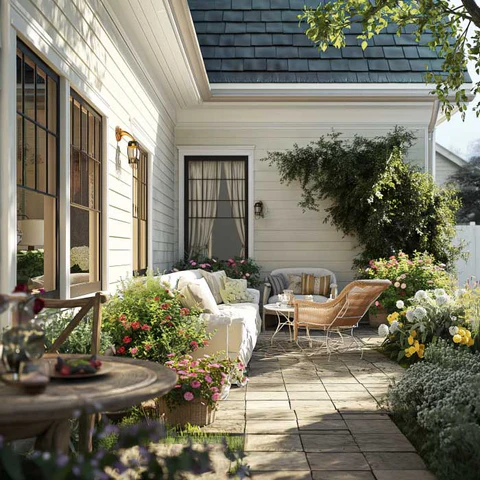
That is why outdoor living ideas are shifting toward tactile contrast instead of decorative overload. Rough stone against soft cushions. Slatted wood beside smooth ceramic. Woven dining chairs near a clean concrete planter. These combinations make a patio feel layered without turning every surface into a display shelf.
Texture also reads better from inside the house. That matters more than people admit. You often view the patio through windows before you step onto it. A textured, balanced space looks calm from a distance, while a heavily accessorized one can look busy even when nothing is happening. That visual quiet helps the backyard feel integrated with the home.
Plants play a major role here too. Not in a maximalist jungle sense, but in controlled movement. Grasses, loose shrubs, and layered foliage soften hard edges and keep the patio from feeling frozen. The goal is not to decorate the backyard. It is to make the hardscape feel alive.
The smartest style choice is knowing when to stop
There is a point in every patio project when improvement turns into interference. One more accent chair. One more color. One more rug. One more planter. This is where people lose the thread. The patio stops feeling considered and starts feeling managed.
Good style has a stopping point. Often earlier than expected. A clean palette, one or two strong materials, and a few pieces with shape or texture will usually do more than a dozen “finishing touches.” You do not need constant novelty if the foundation is right.
This is also where modern backyard design differs from trend-driven decorating. It trusts proportion and atmosphere more than gimmick. You see it in patios that use muted greens, clay tones, charcoal, sand, and warm wood rather than a stack of seasonal color swings. You feel it in spaces where the planting has room to breathe and the furniture does not scream for attention.
The patios people return to most often are not the busiest ones. They are the ones that feel settled. A little softness. A little shade. A layout that makes sense. Lighting that flatters. Enough character to feel personal, but not so much that it becomes tiring. That balance is harder than buying more stuff. It is also what makes the result last.
A patio does not need to prove anything. It needs to welcome you back.
The strongest backyards being built now are not chasing image alone. They are shaped around routine, comfort, and the quiet details that change behavior over time. That is the real lesson behind smart patio trends: the winning spaces are the ones that make you step outside more often without having to talk yourself into it.
So before you buy another accent piece or copy a patio you saw online, pause and audit how your space actually works. Fix the light before the decor. Fix the layout before the accessories. Pick materials you can live with, not simply admire. Then give the patio enough restraint to breathe.
Start with one practical upgrade this week—better lighting, a cleaner seating plan, or shade where you sit longest—and build from there. The right changes do not make your backyard louder. They make it harder to stay inside.
Frequently Asked Questions
What are the biggest smart patio ideas for small backyards?
Lighting control, compact built-in seating, and furniture with hidden storage deliver the most impact in tight spaces. Small patios need fewer objects and sharper choices. When every piece has more than one job, the backyard feels open instead of cramped.
How do I make a modern backyard space feel cozy without clutter?
Focus on texture, shade, and warm lighting first. A woven chair, a soft outdoor cushion, and layered light will do more than filling the patio with decor. Cozy comes from comfort and atmosphere, not from stacking accessories on every surface.
Is smart patio lighting worth the cost for everyday use?
Yes, when it solves a real problem. Dimmable fixtures, scheduled evening lighting, and path lights extend how often you use the patio and improve safety at the same time. The value is not novelty. It is consistency and convenience.
What is the best backyard seating layout for entertaining guests?
Place seats so people can talk without raising their voices and move around without squeezing past furniture. Angled seating, reachable side tables, and one open circulation path usually work better than forcing a perfectly symmetrical arrangement.
Which materials hold up best in modern backyard design?
Matte pavers, powder-coated metal, performance fabrics, and forgiving wood-look finishes tend to age well with normal use. The best material is not the one that looks perfect on day one. It is the one that still works after sun, dust, rain, and traffic.
How can outdoor living ideas improve home value?
A useful patio can raise buyer appeal because it expands the sense of livable space. Buyers respond to backyards that feel ready to use, not ones that require a full redesign. Comfort, lighting, and layout usually matter more than expensive extras.
How often should I update backyard trends and decor?
Review the space once or twice a year, but avoid full redesigns unless the layout is failing. Most patios need small refinements, not seasonal reinvention. Swap textiles, refresh plants, or adjust lighting before replacing major pieces.
What should I avoid when following new patio trends?
Avoid buying features that photograph well but complicate daily use. Oversized furniture, weak lighting plans, heat-trapping materials, and too many decorative objects cause most patio frustration. Trends should support how you live, not pressure you into maintaining a stage set.